



Cracking IBPS in first attempt is possible with the right strategy, consistent practice, and a clear understanding of the exam pattern. Whether you are targeting IBPS PO, IBPS Clerk, or another IBPS recruitment exam, success depends on building strong fundamentals, following the syllabus systematically, practicing questions regularly, and improving speed and accuracy. A focused preparation plan can help you crack IBPS exam confidently instead of relying on last-minute study.
Understand the IBPS Exam Pattern Before Starting
Before beginning preparation, understand the structure of the exam you are targeting. IBPS PO and IBPS Clerk generally involve objective tests covering areas such as English Language, Quantitative Aptitude, and Reasoning Ability in the preliminary stage.
For the main examination, candidates may also face sections such as General Awareness, Banking Awareness, Computer Aptitude, Data Analysis, or related areas depending on the recruitment.
The exact pattern, vacancies, eligibility requirements, and dates can change. Therefore, candidates preparing for the IBPS exam 2026 should always verify the latest official notification before making a detailed study schedule.
Know the Syllabus and Prioritize Important Topics
A clear understanding of the syllabus prevents random preparation. Divide every subject into smaller topics and identify areas that require more practice.
| Section | Important Preparation Areas |
|---|---|
| English Language | Reading Comprehension, Cloze Test, Error Detection, Vocabulary, Fillers |
| Quantitative Aptitude | Simplification, Number Series, Arithmetic, Data Interpretation, Quadratic Equations |
| Reasoning Ability | Puzzles, Seating Arrangement, Syllogism, Inequality, Coding-Decoding, Blood Relations |
| General Awareness | Current Affairs, Banking Awareness, Financial Awareness |
| Computer Aptitude | Computer Fundamentals, Internet, Networking, Basic Applications |
Start with topics that carry regular importance in mock tests and previous exam papers. Once your fundamentals become strong, gradually move toward difficult and time-consuming questions.
Create a Realistic Daily Study Schedule
One of the biggest mistakes candidates make is creating an unrealistic timetable. Studying for long hours is not useful if most of the time is spent passively reading.
Instead, divide your day into focused study sessions.
For example:
- 2 hours: Quantitative Aptitude
- 2 hours: Reasoning Ability
- 1.5 hours: English Language
- 1 hour: Current Affairs and Banking Awareness
- 1 hour: Mock test or sectional practice
- 30 minutes: Revision and error analysis
You can adjust these timings according to your strengths, weaknesses, and available study time.
Consistency matters more than studying for an extreme number of hours for a few days.
Strengthen Your Basics Before Solving Hard Questions
If your concepts are weak, jumping directly into difficult questions can create confusion. Build your foundation first.
For Quantitative Aptitude, understand basic arithmetic concepts, percentages, ratios, averages, profit and loss, simple and compound interest, time and work, and time, speed and distance.
For Reasoning, begin with basic concepts such as inequalities, syllogism, coding-decoding, direction sense, and blood relations before spending more time on complex puzzles.
In English, focus on grammar, vocabulary, sentence structure, and reading comprehension.
Strong fundamentals make it easier to increase both speed and accuracy.
Use Mock Tests to Improve Your Exam Performance
Mock tests are one of the most effective tools for IBPS preparation. They help you understand how well you perform under actual time pressure.
Do not take a mock test merely to check your score. Analyze it afterward.
Look for:
- Questions you answered incorrectly
- Questions that consumed too much time
- Topics where accuracy is low
- Questions you skipped unnecessarily
- Easy questions missed due to pressure
- Sections where time management needs improvement
Maintain an error notebook and record recurring mistakes. Revisiting these mistakes can gradually improve your performance.
Follow Previous Year Papers for Better Preparation
Previous year question papers help you understand the type and difficulty of questions asked in the examination.
They can also reveal recurring concepts and common question formats.
Try solving previous papers within a fixed time limit. After completing them, analyze your performance and compare your approach with faster methods.
This practice is particularly useful when you are looking for a practical trick to crack IBPS exam because it teaches you how to identify question types quickly and select the right solving approach.
Improve Speed Without Sacrificing Accuracy
IBPS examinations are competitive because candidates have to solve a large number of questions within limited time.
However, speed should never come at the cost of accuracy.
Start by solving questions correctly. Once your accuracy becomes stable, introduce time limits and gradually reduce the time required.
For example, if you take five minutes to solve a particular set, practice the same type repeatedly until you can solve it more efficiently without making careless errors.
The objective is not simply to attempt more questions. It is to maximize your score through accurate attempts.
Prepare Current Affairs and Banking Awareness Daily
For candidates targeting IBPS PO and other banking examinations, current affairs should not be postponed until the final weeks.
Spend some time every day reviewing important national and international events, banking developments, financial news, government schemes, appointments, awards, reports, and economic developments.
Create short revision notes rather than trying to memorize large amounts of information at once.
Weekly and monthly revisions will make it easier to retain important facts for the main examination.
Follow a 90-Day IBPS Preparation Strategy
A structured three-month plan can help candidates organize their preparation effectively.
| Preparation Phase | Main Focus |
| Days 1–30 | Concepts, fundamentals, syllabus completion, basic practice |
| Days 31–60 | Advanced questions, sectional tests, previous papers, speed building |
| Days 61–75 | Full-length mocks, current affairs revision, weak-topic improvement |
| Days 76–90 | Intensive revision, mock analysis, shortcuts, exam strategy |
If you have more or less than 90 days, modify the plan accordingly. The important point is to divide preparation into learning, practice, testing, and revision rather than studying everything simultaneously.
Avoid Common Mistakes During IBPS Preparation
Many candidates lose marks because of avoidable preparation mistakes.
One common problem is studying from too many books, websites, and video channels. Too many resources can make revision difficult.
Another mistake is ignoring weak subjects. Candidates often spend more time on subjects they already enjoy while avoiding difficult topics.
Skipping mock-test analysis is another major issue. Taking ten mocks without analyzing mistakes is generally less useful than taking fewer tests and thoroughly reviewing them.
Avoid changing your strategy repeatedly. Once you find a preparation method that works, follow it consistently and make changes only when your performance data indicates a problem.
Choose the Best Coaching Center for Structured Guidance
Self-study can work well for disciplined candidates, but professional guidance can make preparation more structured. A good coaching institute can provide experienced faculty, organized study material, regular tests, doubt-solving support, and a competitive learning environment.
When selecting the best coaching center, do not choose an institute only because of advertisements or claims about results.
Consider factors such as:
- Faculty experience
- Quality of study material
- Batch size
- Frequency of mock tests
- Doubt-solving support
- Updated syllabus coverage
- Previous student feedback
- Distance and class timings
- Overall learning environment
For students looking for Sec 34 best Bank Coaching Institute in Chandigarh, comparing these factors can help them choose an institute that matches their preparation needs.
Bank Coaching in Chandigarh provides structured guidance for banking exam aspirants with a focus on concepts, practice, mock tests, and exam-oriented preparation.
Build a Revision System That Actually Works
Revision should be part of your daily routine rather than something reserved for the final week.
Use short revision cycles. Review topics after learning them, then revisit them after a few days and again after a longer interval.
Maintain separate notes for formulas, important vocabulary, current affairs, banking terms, and frequently repeated mistakes.
Before the examination, these concise notes can save considerable time because you will not need to revisit every chapter from the beginning.
Stay Consistent and Track Your Progress
Preparation becomes easier when you measure your progress.
Every week, record your mock scores, accuracy, attempts, average time per section, and frequently occurring mistakes.
For example, if your Quantitative Aptitude accuracy is 75% and your Reasoning accuracy is 90%, you know where additional practice is needed.
Do not compare your progress only with other candidates. Compare your current performance with your previous scores.
A gradual improvement in accuracy, speed, and confidence is a strong indicator that your strategy is working.
What Is the Best Way to Crack IBPS in First Attempt?
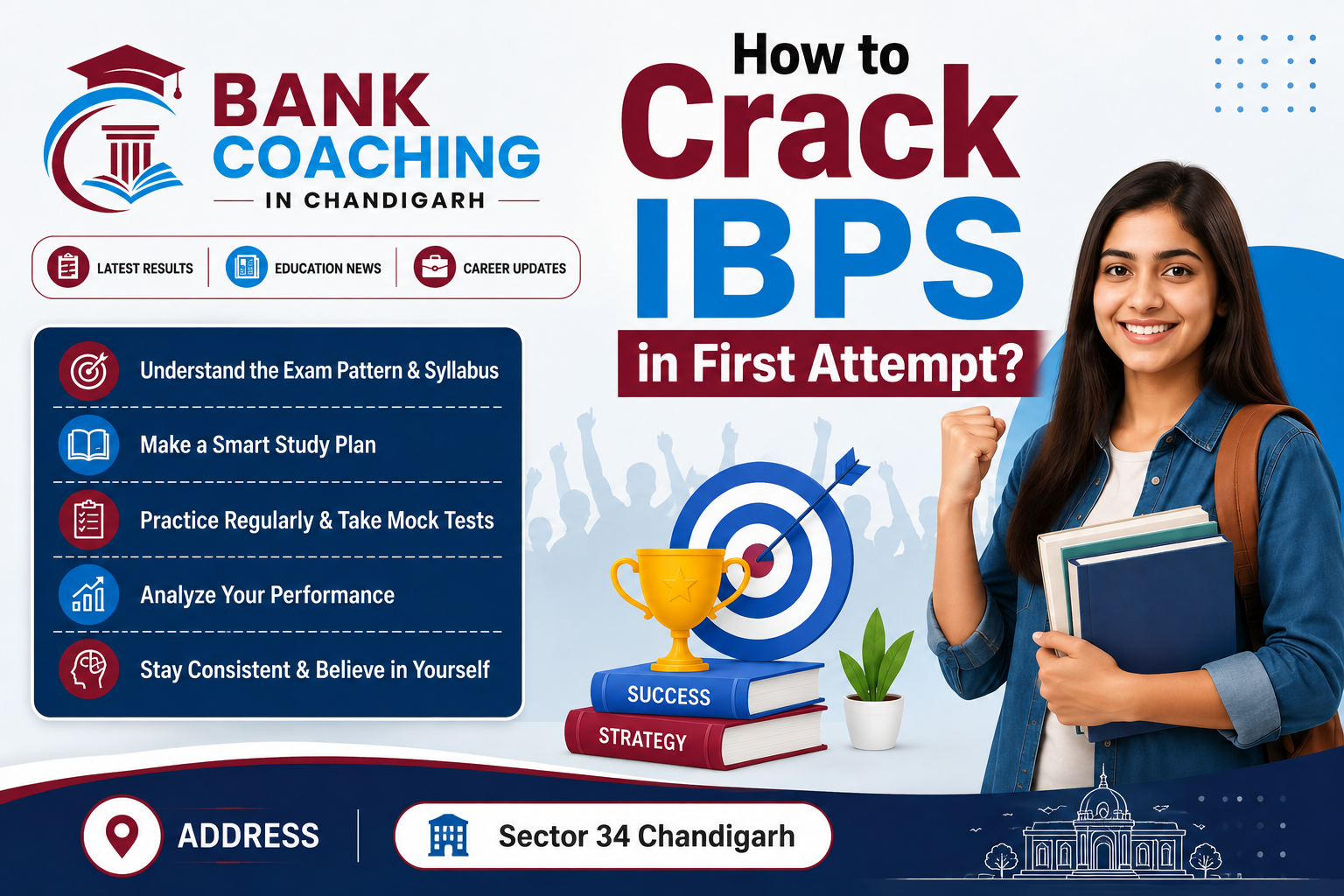
There is no single shortcut that guarantees success. The most effective approach combines five elements: understanding the syllabus, strengthening concepts, practicing regularly, taking mock tests, and revising consistently.
Candidates should also learn when to skip a question. Spending several minutes on one difficult question can reduce the opportunity to solve multiple easier questions.
A successful IBPS strategy is therefore not about attempting everything. It is about making smart decisions within the available time.
Final Strategy to Crack IBPS Exam Successfully
If your goal is to crack IBPS in first attempt, begin with a clear target and a realistic preparation schedule. Understand the syllabus, build your fundamentals, solve previous year questions, practice sectional tests, take full-length mocks, and analyze every mistake.
Keep your resources limited and revise them repeatedly. Stay updated with current affairs and banking awareness, particularly if you are preparing for the main examination.
Most importantly, remain consistent. Banking exams reward candidates who combine knowledge with speed, accuracy, discipline, and effective time management.
For aspirants who want structured preparation and expert guidance, Bank Coaching in Chandigarh can help create a focused learning routine and provide exam-oriented support. Start preparing today, strengthen your weak areas, and take a confident step toward cracking your IBPS examination.
Frequently Asked Questions About IBPS Preparation
1. Can I crack IBPS in first attempt without coaching?
Yes, many candidates prepare through self-study. However, coaching can provide structured classes, study material, mock tests, doubt support, and a planned preparation approach. Your choice should depend on your learning style, discipline, and preparation requirements.
2. How many hours should I study for IBPS every day?
There is no fixed number of hours suitable for everyone. Around 5–8 focused hours can be effective for many serious aspirants, provided the time includes concept learning, practice, mock tests, current affairs, and revision.
3. What should I study first for the IBPS exam?
Begin by understanding the latest syllabus and exam pattern. Then identify your weak areas and build basic concepts in Quantitative Aptitude, Reasoning, and English before moving to advanced questions and intensive mock-test practice.
4. Are mock tests important for cracking IBPS?
Yes. Mock tests help improve time management, question selection, speed, and accuracy. Their real value comes from analyzing mistakes after every test and working specifically on recurring weaknesses.
5. What is the best trick to crack IBPS exam quickly?
The most practical strategy is to combine consistent practice with smart question selection. Focus on high-priority topics, improve accuracy first, practice timed tests, analyze mistakes, and revise regularly instead of depending on a single shortcut.