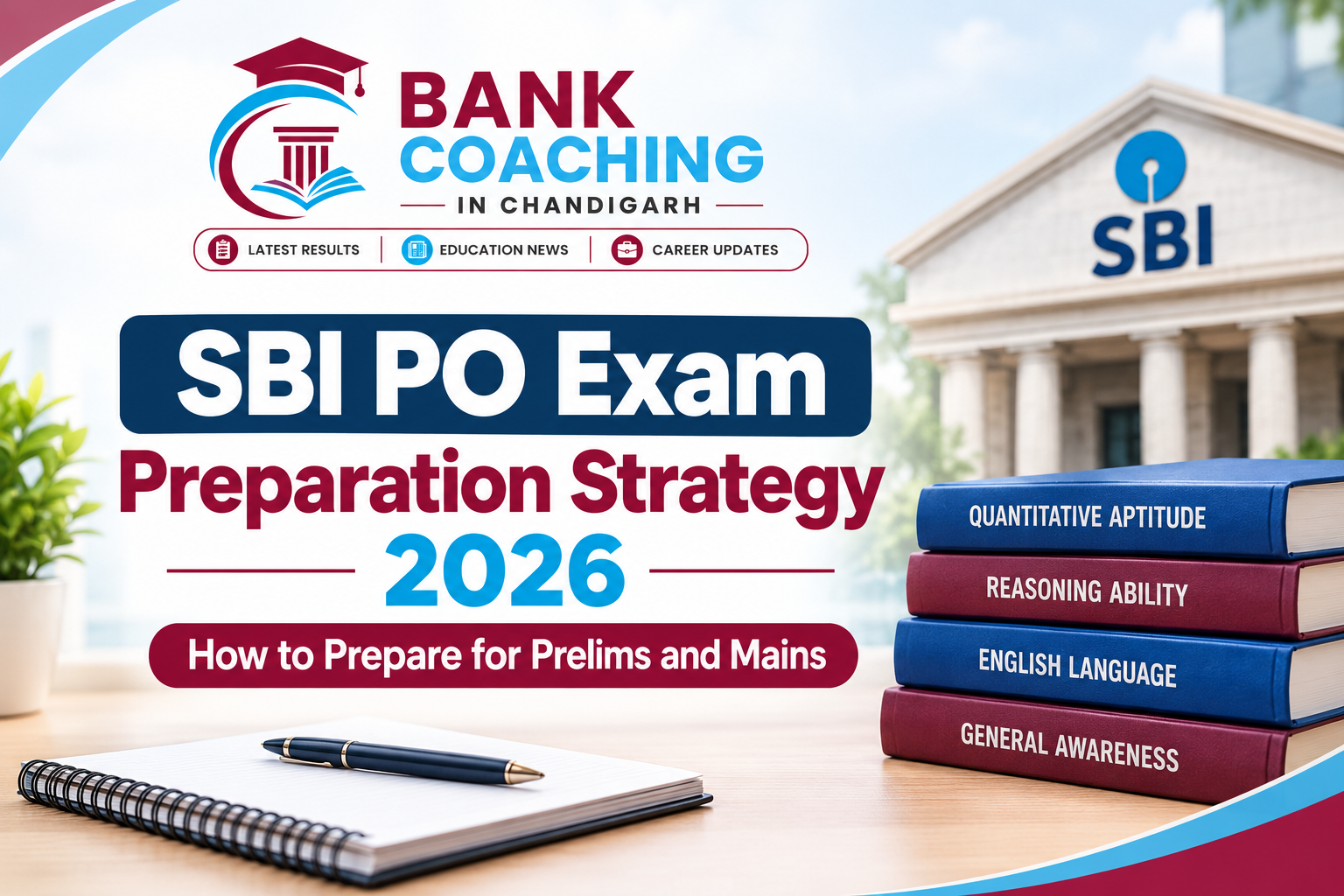

The SBI PO Exam Preparation Strategy 2026 should focus on building strong concepts, improving speed and accuracy, practising exam-level questions, and maintaining consistency. Since the SBI PO selection process tests candidates across multiple subjects and stages, preparing for Prelims and Mains with separate but connected strategies is essential. A structured timetable, regular mock tests, current affairs revision, and previous-year paper practice can help aspirants make their preparation more focused and measurable.
Understand the SBI PO Exam Pattern Before Preparing
Before starting preparation, candidates should understand the structure of the examination. The Prelims stage is designed to test basic aptitude, reasoning, and English skills under strict time limits, while Mains requires deeper conceptual understanding, analytical ability, awareness, and effective time management.
SBI PO Prelims Pattern: 100 Marks in 60 Minutes
The SBI PO Prelims examination carries 100 marks and has a duration of 60 minutes. Candidates need to manage three sections within the prescribed sectional time limits.
| Section | Marks | Preparation Focus |
|---|---|---|
| English Language | 30 | Grammar, vocabulary, reading comprehension |
| Quantitative Aptitude | 35 | Arithmetic, simplification, DI, number-based questions |
| Reasoning Ability | 35 | Puzzles, seating arrangement, logical reasoning |
| Total | 100 | 60 Minutes |
The objective should not simply be attempting the maximum number of questions. Candidates should aim for a combination of speed, accuracy, and question selection.
SBI PO Mains Pattern: 230 Marks in 3 Hours 30 Minutes
The Mains examination requires a more advanced preparation approach. As per the pattern being used for this preparation plan, the examination carries 230 marks with a total duration of 3 hours 30 minutes.
Mains preparation should begin alongside Prelims rather than being postponed until after the first stage. Topics such as data interpretation, advanced reasoning, banking awareness, current affairs, and descriptive writing require sustained practice.
Build a Subject-Wise SBI PO Preparation Strategy
A subject-wise approach makes preparation easier to organise. Instead of spending the entire day on one subject, divide study hours according to your strengths, weaknesses, and the weight of important topics.
The objective should be to develop three things simultaneously: conceptual clarity, question-solving speed, and accuracy.
Quantitative Aptitude Strategy for SBI PO 2026
Quantitative Aptitude can become time-consuming if candidates rely only on lengthy calculations. Start by strengthening basic concepts before moving towards difficult questions.
Important areas include simplification, approximation, number series, quadratic equations, percentages, profit and loss, ratio and proportion, averages, time and work, time and distance, simple and compound interest, probability, permutation and combination, and data interpretation.
Improve Calculation Speed With Daily Practice
Spend some time every day on calculations. Practise squares, cubes, fractions, percentage conversions, multiplication shortcuts, and approximation techniques.
For Data Interpretation, learn to identify what the question is actually asking before calculating. Avoid spending several minutes on a single complicated set during timed practice.
For Mains, gradually introduce caselet DI, missing DI, arithmetic-based DI, and other calculation-intensive sets.
Reasoning Preparation for SBI PO Prelims and Mains
Reasoning requires both logical understanding and familiarity with different question patterns. Puzzles and seating arrangements can consume significant time, so candidates should practise them regularly.
Begin with topics such as inequalities, syllogism, coding-decoding, direction sense, blood relations, alphanumeric series, order and ranking, and miscellaneous logical reasoning.
After developing the basics, move to floor-based puzzles, box-based puzzles, scheduling, circular arrangements, linear arrangements, and other complex sets.
Use a Smart Approach for Difficult Puzzles
Do not become attached to one puzzle simply because you have already spent time on it. During mock tests, learn to identify solvable sets quickly.
For Mains preparation, focus on reasoning sets that require multiple conditions and logical deductions. Maintain an error notebook and record the reason behind every mistake.
English Preparation for SBI PO 2026
English preparation should combine grammar, vocabulary, reading ability, and question-solving practice. Reading comprehension, cloze tests, error detection, sentence rearrangement, fillers, and vocabulary-based questions should be included in the weekly schedule.
Read quality newspapers, editorials, business articles, and reliable current-affairs material regularly. The purpose is not to memorise every unfamiliar word but to understand sentence structure, context, and meaning.
Strengthen Grammar and Reading Comprehension
Revise fundamental grammar rules covering subject-verb agreement, tenses, articles, prepositions, conjunctions, modifiers, and sentence structure.
For reading comprehension, practise identifying the central idea, tone, inference, and supporting details. Gradually increase the difficulty and length of passages.
Maintaining a vocabulary notebook with useful words, meanings, synonyms, antonyms, and examples can make revision more effective.
Current Affairs and General Awareness Preparation
General Awareness becomes particularly important for Mains preparation. Candidates should follow banking and financial developments along with major national and international events.
Focus on areas such as RBI updates, monetary policy, banking terms, financial institutions, government schemes, appointments, reports, awards, important economic developments, and major national events.
Follow a Consistent Current Affairs Routine
Avoid collecting current-affairs PDFs without revising them. A practical routine is to study current affairs regularly and revise them at fixed intervals.
Make short notes for important facts. Monthly revision is particularly useful because it helps candidates connect individual events with broader banking and economic developments.
For Mains, do not restrict preparation to one-line facts. Understand the background and significance of major banking and financial developments.
Mock Tests and Previous-Year Papers for SBI PO
Mock tests are an essential part of a practical SBI PO preparation strategy. They help candidates understand how well their preparation works under actual time pressure.
Start with sectional tests after completing the fundamentals. Later, introduce full-length Prelims and Mains mocks.
After every test, spend sufficient time analysing your performance.
| Mock Analysis Area | What to Check |
|---|---|
| Accuracy | Which questions were answered incorrectly? |
| Time | Which section consumed excessive time? |
| Selection | Which questions should have been skipped? |
| Concepts | Which topics need revision? |
| Attempts | Were attempts consistent with accuracy? |
Previous-year papers are equally useful. They help candidates understand recurring concepts, question formats, difficulty levels, and the type of reasoning required.
Do not merely solve previous papers. Analyse them and identify patterns in your mistakes.
A Practical SBI PO Study Plan for 2026
A realistic study plan should be flexible enough to accommodate revision, mock tests, and weaker subjects. Candidates preparing for both stages can divide their preparation into phases.
Phase 1: Build Concepts and Cover the Syllabus
During the initial phase, concentrate on fundamentals. Cover important topics in Quantitative Aptitude, Reasoning, and English while beginning daily current-affairs preparation.
Avoid rushing through the syllabus simply to mark topics as completed. Make sure you can solve basic and moderate questions independently.
Phase 2: Increase Practice and Timed Questions
Once the fundamentals are reasonably strong, increase the number of practice questions. Introduce sectional tests and start solving previous-year questions.
Work on speed without compromising accuracy. Identify topics that repeatedly cause errors and allocate additional practice time to them.
Phase 3: Full-Length Mocks and Revision
In the final phase, shift your focus towards full-length mocks, revision, current affairs, and exam-specific practice.
Practise according to the actual time limits. Develop a clear strategy for deciding which questions to attempt first and which ones to leave.
A simple daily schedule could look like this:
| Activity | Suggested Focus |
|---|---|
| Quantitative Aptitude | Concepts + timed practice |
| Reasoning | Puzzles + miscellaneous questions |
| English | Reading + grammar + practice |
| Current Affairs | Daily banking and national updates |
| Mock/Sectional Test | Test + detailed analysis |
| Revision | Formulas, vocabulary, errors |
The exact hours can be adjusted according to whether you are a college student, working professional, or full-time aspirant.
Common Preparation Mistakes to Avoid
Even a long study schedule may not produce effective preparation if the approach is incorrect. Avoid studying without measurable targets or continuously switching between multiple resources.
One common mistake is focusing exclusively on Prelims. Mains preparation should begin early because its syllabus and question requirements need additional practice.
Another mistake is taking mock tests without analysing them. A mock test is useful only when you understand why questions went wrong and how your approach can improve.
Candidates should also avoid ignoring current affairs until the final weeks. Regular revision is more manageable than trying to memorise several months of information at once.
Finally, do not sacrifice accuracy simply to increase attempts. Timed practice should help you develop better question selection rather than encouraging random guessing.
How Coaching Can Support SBI PO Preparation?
Self-study can be structured effectively, but some aspirants prefer expert guidance, organised study material, doubt support, and regular testing.
Bank Coaching In Chandigarh provides a structured preparation environment for banking exam aspirants, helping students work on concepts, practice, mock tests, and exam-oriented preparation.
The right preparation method ultimately depends on your current level, available study time, and the areas where you need additional support. Whether you choose self-study, coaching, or a combination of both, consistency remains essential.
Final SBI PO Preparation Tips for 2026
SBI PO preparation should be treated as a continuous process rather than a last-minute exercise. Start with the syllabus and exam pattern, strengthen your fundamentals, practise questions regularly, and progressively introduce timed tests.
Give equal importance to learning and revision. Track your mock-test performance and maintain an error log so that repeated mistakes can be reduced.
Keep current affairs preparation consistent and begin Mains-oriented preparation early. Most importantly, create a study plan that you can actually follow every day.
If you are looking for structured guidance, regular practice, mock-test support, and exam-focused preparation, Bank Coaching In Chandigarh can help you organise your SBI PO preparation journey. Start preparing with a clear strategy, strengthen your concepts, practise consistently, and take the next step toward your banking career today.
Frequently Asked Questions About SBI PO Preparation
1. How should I start SBI PO preparation in 2026?
Start by understanding the syllabus and exam pattern. Assess your current level through a basic test, then build concepts in Quantitative Aptitude, Reasoning, and English while beginning daily current-affairs preparation.
2. Can I prepare for SBI PO Prelims and Mains together?
Yes. Preparing both stages together is practical because several foundational subjects overlap. However, Mains-specific areas such as advanced reasoning, Data Interpretation, General Awareness, and descriptive preparation should receive regular attention.
3. How many hours should I study for SBI PO?
There is no fixed number of hours suitable for every aspirant. Focus on productive study rather than a particular hour target. Divide your available time between concepts, practice, current affairs, mock tests, analysis, and revision.
4. Are previous-year papers important for SBI PO preparation?
Yes. Previous-year papers help candidates understand question formats, recurring concepts, difficulty patterns, and time requirements. They should be solved under timed conditions and analysed after completion.
5. When should I start taking SBI PO mock tests?
You can begin with sectional tests after developing basic concepts. As preparation progresses, include full-length Prelims and Mains mocks and analyse every test to identify weaknesses in accuracy, speed, and question selection.