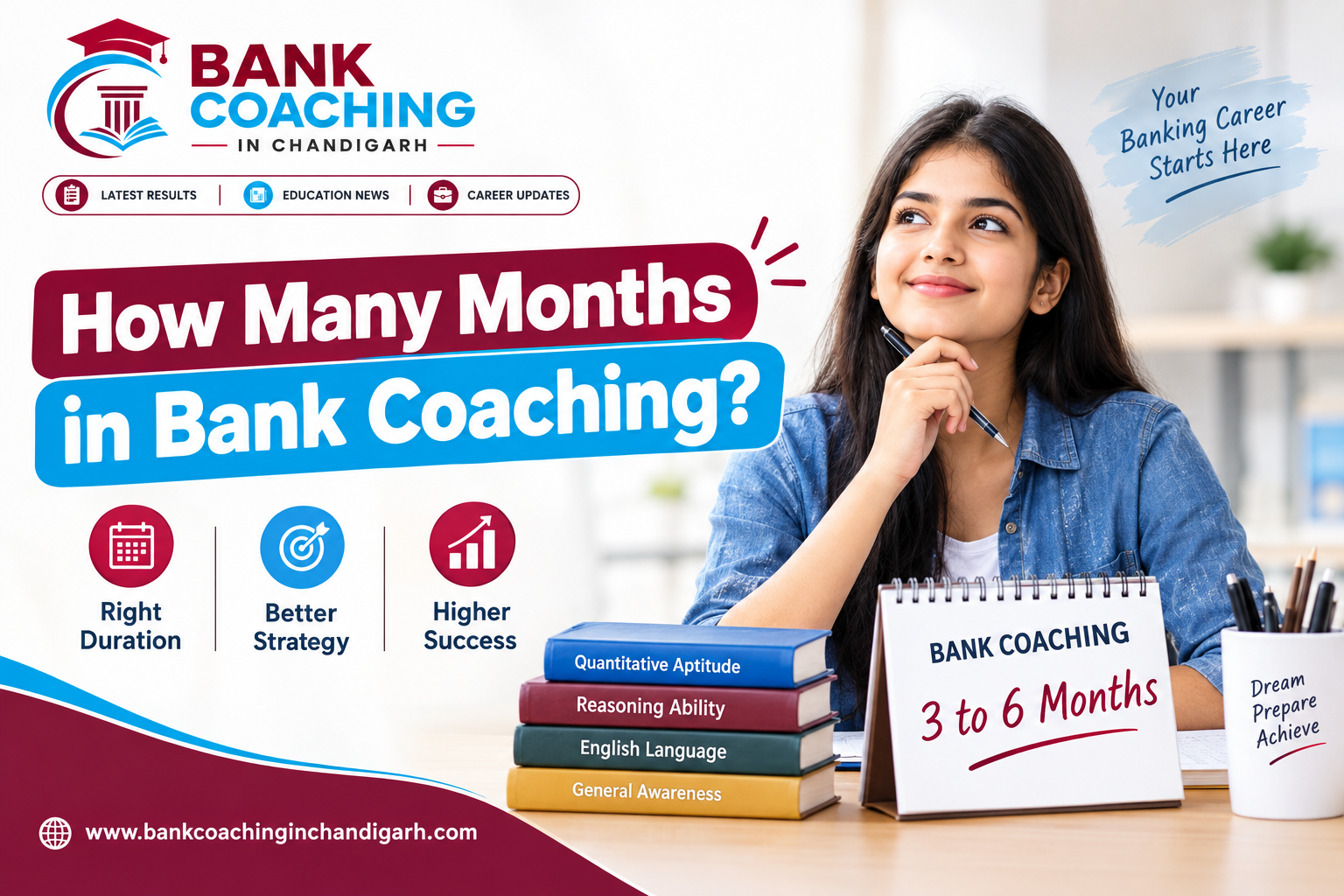
The duration of bank coaching usually depends on the exam you are targeting, your current preparation level, and the amount of time you can study each day. For most banking aspirants, a structured coaching program may run for around 3 to 6 months, while students preparing for multiple exams may prefer a longer 6–12 month preparation cycle. The right duration is less about completing a fixed number of months and more about covering the syllabus, building accuracy, practicing questions, and becoming comfortable with mock tests.
How Long Does Bank Coaching Usually Take?
There is no single duration that works for every banking aspirant. Different institutes offer different course structures based on the examination, syllabus, and preparation level of students.
A focused course for exams such as IBPS Clerk, SBI Clerk, IBPS PO, or SBI PO may commonly be structured around a few months of classroom or online instruction. Students who already have a strong foundation may require less time, while beginners may benefit from additional practice and revision.
A typical preparation timeline can look like this:
| Preparation Stage | Approx. Duration | Main Focus |
|---|---|---|
| Foundation | 1–2 months | Basic concepts and fundamentals |
| Syllabus Coverage | 2–3 months | Quantitative Aptitude, Reasoning, English and other subjects |
| Practice | 1–2 months | Sectional tests and question practice |
| Revision & Mocks | 1 month or more | Full-length mocks, revision and exam strategy |
| Complete Preparation | 4–6 months | Balanced preparation for most aspirants |
These periods are flexible. Someone with a strong academic background may move faster, whereas a beginner may need additional time to develop calculation speed, reasoning skills, vocabulary, and exam awareness.
Which Factors Decide the Duration of Bank Coaching?
The number of months you need should be determined by your individual preparation requirements rather than simply choosing the longest course available.
Your Current Level of Preparation
Students starting from the basics generally need more time to understand fundamental concepts. For example, a beginner may need several weeks to become comfortable with percentages, ratios, averages, simplification, number systems, puzzles, grammar, and reading comprehension.
Students who have already prepared for competitive examinations may spend more time on advanced practice, speed improvement, and mock-test analysis.
The Banking Exam You Are Targeting
The required preparation period can vary according to the examination.
Bank PO examinations generally require preparation across multiple sections, including Quantitative Aptitude, Reasoning Ability, English Language, General Awareness, and other areas depending on the specific exam pattern.
Clerk-level examinations can also require extensive practice because candidates need to solve questions accurately within limited time.
If you are preparing for multiple exams such as IBPS PO, SBI PO, IBPS Clerk, and SBI Clerk, a longer preparation schedule can help you cover overlapping topics while adapting to differences in their patterns.
Your Daily Study Time
The number of months required also depends on how many hours you can devote to preparation.
A student studying consistently for several hours each day may complete the syllabus and practice cycle faster than someone who can study only occasionally.
However, studying for a large number of hours without a plan is not necessarily productive. Consistency, revision, question practice, and mock-test analysis are more important than simply counting study hours.
Is Three Months Enough for Bank Exam Preparation?
Three months can be enough for focused preparation if you already have a reasonable understanding of the fundamentals and can maintain a disciplined study schedule.
During the first month, concentrate on building or strengthening concepts. Cover important topics in Quantitative Aptitude, Reasoning, and English while beginning regular current-affairs preparation.
The second month should combine syllabus completion with intensive question practice. Start solving sectional tests and identify topics where accuracy or speed is weak.
During the third month, increase the frequency of mock tests. Analyze every test carefully rather than simply checking your score. Identify questions that consumed excessive time, mistakes caused by calculation errors, and concepts that require another revision.
For beginners with weak fundamentals, three months may feel restrictive. In that situation, extending the preparation period can provide more time for concept building and revision.
Is Six Months Better for Complete Preparation?
A six-month preparation cycle can provide more flexibility, particularly for beginners or candidates preparing for multiple banking examinations.
The first two months can be dedicated to fundamentals and basic question types. The next two months can focus on advanced practice and syllabus completion. The final two months can emphasize mock tests, revision, previous-year questions, and speed improvement.
A six-month plan can also reduce the pressure of trying to learn everything immediately before an examination.
However, a longer preparation period does not automatically guarantee better results. Without regular practice and measurable progress, students can spend months studying without addressing their actual weaknesses.
What Should Bank Coaching Cover During the Course?
A useful coaching program should go beyond simply explaining chapters. It should help students understand concepts, apply them to exam-level questions, improve speed, and learn how to manage the examination effectively.
Quantitative Aptitude and Calculation Skills
Quantitative Aptitude requires both conceptual understanding and calculation speed.
Important areas can include simplification, approximation, number series, percentages, profit and loss, ratio and proportion, averages, time and work, time and distance, data interpretation, and other arithmetic topics.
Regular practice is important because knowing a formula is different from applying it quickly during an examination.
Reasoning and Puzzle Practice
Reasoning preparation can include inequalities, syllogism, coding-decoding, blood relations, direction-based questions, seating arrangements, and different types of puzzles.
As preparation progresses, students should move from basic questions to exam-level sets and timed practice.
English Language Preparation
English preparation generally requires a combination of grammar, vocabulary, reading comprehension, sentence-based questions, and regular reading.
Students should not treat English as a subject that can be completed in a few days. Consistent reading and question practice can gradually improve comprehension and accuracy.
General Awareness and Current Affairs
For banking examinations that include General Awareness or current-affairs sections, candidates should maintain a regular study routine.
Important banking and financial awareness topics should be revised alongside national and international current events relevant to the examination.
Why Mock Tests Matter During Bank Coaching?
Mock tests should become an important part of preparation well before the final examination.
Initially, students can use sectional tests to understand their performance in individual subjects. Once the syllabus is substantially covered, full-length tests can help replicate examination conditions.
The real benefit comes from analyzing the test afterward.
Ask questions such as:
- Which topics produced the most mistakes?
- Which questions took too much time?
- Were errors caused by concepts or careless calculation?
- Which sections were completed comfortably?
- Which questions should have been skipped?
- Did accuracy decrease because of time pressure?
This analysis helps turn mock tests into a learning tool rather than simply a scorecard.
How Bank Coaching Can Improve Your Preparation?
A structured coaching program can provide a clear study direction when students are unsure about what to study and when to study it.
At Bank Coaching In Chandigarh, preparation can be supported through experienced faculty, regular mock tests, updated study material, personalized mentorship, and time-management guidance.
Experienced faculty can simplify difficult concepts and explain different approaches to solving exam-level questions. Regular mock tests help students measure progress and work on speed and accuracy.
Updated study material can also save preparation time by bringing relevant concepts, practice questions, and revision resources into a structured format.
Personalized guidance is particularly useful when students repeatedly struggle with the same topics. Instead of following the same strategy for everyone, preparation can be adjusted according to individual performance.
A Practical Six-Month Bank Preparation Plan
Students looking for a structured timeline can divide their preparation into six stages.
Month 1: Build Strong Fundamentals
Start with the basics of Quantitative Aptitude, Reasoning, and English. Understand the examination pattern and identify your strengths and weaknesses through an initial assessment.
Month 2: Strengthen Core Topics
Complete more syllabus areas and increase daily question practice. Begin maintaining short revision notes for formulas, grammar rules, shortcuts, and important concepts.
Month 3: Increase Question Practice
Move towards moderate and exam-level questions. Start taking regular sectional tests and track your accuracy and average solving time.
Month 4: Complete Major Syllabus Areas
Focus on remaining important topics while continuing revision. Introduce more mixed-question practice so you become comfortable switching between different question types.
Month 5: Focus on Mocks and Revision
Increase full-length mock tests and analyze them thoroughly. Work specifically on weak areas identified through your test performance.
Month 6: Final Revision and Exam Strategy
Revise important concepts, formulas, vocabulary, current affairs, and frequently tested topics. Take timed mocks and develop a clear strategy for attempting different sections.
This plan can be shortened or extended depending on the candidate’s starting level and examination schedule.
How to Know When Your Coaching Is Complete?
Completing a coaching course does not necessarily mean that your preparation is complete.
You should consider yourself closer to exam readiness when you can consistently solve questions within the required time, maintain reasonable accuracy, understand the common question patterns, and perform steadily in full-length mock tests.
You should also be able to identify which questions to attempt first and which questions to leave when they are consuming too much time.
The goal is not merely to finish every chapter. The goal is to develop the skills required to perform effectively under examination conditions.
Should You Join Short-Term or Long-Term Bank Coaching?
The choice depends on your preparation level.
A 3-month course may suit candidates who already understand the basics and need structured practice, revision, and exam-focused preparation.
A 4–6 month course can be useful for candidates who want a balanced combination of fundamentals, syllabus coverage, practice, and mock tests.
A 6–12 month preparation cycle may be more suitable for beginners, students preparing alongside college or work, or candidates targeting several banking examinations.
Instead of choosing a course only by duration, compare what the program actually provides. Look at faculty experience, study material, mock-test frequency, doubt support, syllabus coverage, revision sessions, and performance analysis.
Frequently Asked Questions
1. How many months are required for bank coaching?
Most candidates can follow a structured bank coaching program for around 3–6 months, depending on their preparation level and target examination. Beginners may need additional preparation time.
2. Can I prepare for a bank exam in three months?
Yes, three months can provide enough time for focused preparation for some candidates, particularly those with strong fundamentals. The schedule should include concept revision, intensive practice, mock tests, and regular analysis.
3. Is six months enough for bank exam preparation?
Six months can provide a balanced preparation window for many aspirants. It allows time for fundamentals, syllabus completion, practice, revision, and mock tests.
4. How many hours should I study during bank coaching?
There is no universal number of hours that guarantees success. A consistent daily schedule combining concepts, question practice, revision, current affairs, and mock-test analysis is generally more useful than simply studying for long hours.
5. Should beginners join bank coaching for six months?
Beginners may benefit from a longer structured program because they have more time to develop fundamentals, practice different question types, improve calculation and reasoning speed, and receive guidance on exam strategy.
Start Your Bank Exam Preparation With the Right Plan
The ideal duration of bank coaching depends on where you are starting, which examination you are targeting, and how consistently you can prepare. For many aspirants, 3–6 months provides a practical framework, while beginners or candidates targeting multiple examinations may benefit from a longer preparation cycle.
A structured approach can make the preparation process more organized by combining expert guidance, updated study material, regular mock tests, personalized mentorship, and time-management techniques. If you are preparing for banking examinations in Chandigarh, connect with Bank Coaching In Chandigarh and choose a preparation plan that matches your goals, current level, and examination timeline. Start preparing with the right strategy today and take a focused step toward your banking career.