
If you are wondering, “Can I crack bank PO in 1 year?”, the answer is yes. One year is a realistic preparation period for candidates who follow a structured study plan, understand the bank PO exam pattern, practise consistently, and regularly analyse their performance. Whether you are a college student, working professional, or graduate starting from scratch, 12 months can provide enough time to build concepts, improve speed, practise questions, and prepare for the selection stages.
The bank PO selection process generally requires preparation for subjects such as English Language, Quantitative Aptitude, Reasoning Ability, General/Financial Awareness and, depending on the exam, descriptive or other qualifying components. The exact pattern, eligibility and stages can differ between examinations such as SBI PO and IBPS PO, so candidates should always check the latest official notification before applying.
Is One Year Enough to Crack a Bank PO Exam?
Yes, one year can be enough if you use the time productively. The biggest advantage of a 12-month preparation window is that you do not need to rush through the syllabus.
Instead, you can divide your preparation into different stages:
| Preparation Stage | Suggested Duration | Main Focus |
|---|---|---|
| Foundation | 1–3 months | Basic concepts and fundamentals |
| Concept Building | 4–6 months | Complete syllabus and topic practice |
| Intensive Practice | 7–9 months | Sectional tests and advanced questions |
| Mock-Test Phase | 10–11 months | Full-length tests and analysis |
| Final Revision | 12th month | Revision, current affairs and weak areas |
This approach is particularly useful for beginners because it gives them time to understand difficult topics instead of simply memorising shortcuts.
What Makes Bank PO Preparation Challenging?
A bank PO exam is competitive because thousands of candidates prepare for a limited number of vacancies. However, the difficulty is not necessarily because every question is extremely advanced.
The real challenge is speed, accuracy, consistency and competition.
Candidates often know how to solve a question but lose marks because they spend too much time on it. Others make avoidable mistakes due to inadequate revision or insufficient mock-test practice.
Therefore, preparation should focus on three things:
- Building strong concepts
- Increasing solving speed
- Maintaining accuracy under time pressure
How to Crack Bank PO in 1 Year Step by Step?
A one-year plan should not mean studying randomly for 365 days. Every phase should have a specific objective.
Months 1–3: Build Your Banking Exam Foundation
During the first three months, focus on understanding the basics.
For Quantitative Aptitude, start with arithmetic fundamentals, percentages, ratio and proportion, averages, profit and loss, simple and compound interest, time and work, time and distance, and data interpretation.
Reasoning, develop your understanding of inequalities, syllogism, coding-decoding, blood relations, direction sense, ranking and basic puzzles.
English, work on grammar, vocabulary, reading comprehension, error detection, sentence improvement and basic verbal ability.
At this stage, accuracy matters more than speed.
Months 4–6: Complete the Core Syllabus
Once your fundamentals are stronger, move towards more exam-oriented preparation.
Increase your question-solving practice and start working on moderate-level puzzles, data interpretation sets, reading comprehension and other frequently tested topics.
You should also begin taking sectional tests.
Do not simply check your score after a test. Analyse:
- Which questions were incorrect?
- Which questions took too long?
- Which topics are repeatedly causing mistakes?
- Did you guess answers unnecessarily?
- Which section consumed the most time?
This analysis helps convert practice into measurable improvement.
Months 7–9: Focus on Speed and Exam-Level Practice
The next three months should be dedicated to intensive practice.
Start solving questions with a timer. Gradually increase the difficulty level and practise mixed-topic sets rather than solving only one type of question repeatedly.
This is also the right time to increase your mock-test frequency.
A useful weekly routine could include:
| Activity | Recommended Frequency |
| Quantitative Aptitude Practice | 5–6 days |
| Reasoning Practice | 5–6 days |
| English Practice | 5–6 days |
| Current Affairs/Banking Awareness | Daily |
| Sectional Tests | 3–4 per week |
| Full-Length Mock Tests | 1–2 per week |
| Mock Analysis | After every mock |
The exact schedule should be adjusted according to your strengths and weaknesses.
Months 10–11: Take Full-Length Mock Tests
By this stage, you should be comfortable with most of the syllabus.
Your priority now should be exam simulation.
Attempt full-length mock tests under the actual time limit. Try different section-order strategies and identify the approach that gives you the best combination of speed and accuracy.
Mock tests are not only for checking your marks. They help you develop exam temperament.
A candidate who consistently scores well in untimed practice may still struggle in the actual examination if they have not practised under pressure.
Month 12: Revise Instead of Starting New Topics
The final month should focus primarily on revision and consolidation.
Revise formulas, grammar rules, frequently missed concepts, shortcuts, vocabulary and important notes. Continue taking mocks but spend sufficient time analysing them.
For General and Financial Awareness, revise relevant current affairs and banking-related developments according to the examination’s requirements.
Avoid filling the final weeks with too many new resources. A smaller set of well-revised material is generally more useful than several incomplete sources.
How Many Hours Should You Study for Bank PO?
There is no universal number of hours that guarantees success. The quality and consistency of study matter more than simply counting hours.
A beginner may start with around 3–4 focused hours per day and gradually increase study time according to their schedule. Students preparing full-time may be able to devote more hours, while working candidates can focus on shorter but highly structured sessions.
A possible daily routine is:
- 60–75 minutes for Quantitative Aptitude
- 60–75 minutes for Reasoning
- 45–60 minutes for English
- 30–45 minutes for current affairs and banking awareness
- 30–45 minutes for revision or test analysis
The important point is to maintain consistency throughout the year.
Which Subjects Need the Most Practice?
Every candidate has different strengths, but some areas commonly require substantial practice.
Quantitative Aptitude
Focus on arithmetic, data interpretation, number-based concepts and calculation speed. Regular practice can help reduce the time required for calculations.
Reasoning Ability
Puzzles and seating arrangements can be time-consuming. Practise different formats and learn how to identify the most manageable sets during an examination.
English Language
Reading regularly can improve comprehension, vocabulary and familiarity with sentence structures. Along with reading, practise grammar and exam-style questions.
General and Financial Awareness
This section requires consistent revision rather than last-minute preparation. Follow reliable current-affairs sources and revise banking and financial awareness topics relevant to your examination.
Can Coaching Help You Crack Bank PO in One Year?
Self-study can work, but structured Bank PO Coaching can make preparation more organised, particularly for beginners or candidates who struggle to maintain a routine.
A good coaching programme can provide:
- Structured syllabus coverage
- Experienced faculty
- Exam-oriented study material
- Regular mock tests
- Doubt-solving support
- Performance analysis
- Time-management techniques
- A competitive learning environment
The objective should not be to depend entirely on coaching. Use classes to understand concepts and strategies, then strengthen those concepts through independent practice.
For candidates looking for Sec 34 Chandigarh Bank PO Coaching, compare faculty experience, batch size, mock-test quality, study resources, doubt support, class schedules and the overall learning environment before making a decision.
Why Choose Bank Coaching in Chandigarh?
Bank Coaching in Chandigarh focuses on structured preparation designed around the requirements of competitive banking examinations.
Experienced Faculty
Learn from qualified mentors with extensive banking exam coaching experience.
Regular Mock Tests
Practise with exam-level tests to improve speed, accuracy and confidence.
Updated Study Material
Use structured notes, practice sets and preparation resources to support daily learning.
Personalized Mentorship
Get individual guidance, performance analysis and doubt support where required.
Time Management Skills
Learn practical techniques for selecting questions and solving them efficiently within the examination time.
The right learning environment can help you stay consistent throughout your one-year preparation journey. However, your personal practice, revision and mock-test analysis remain essential.
Common Mistakes to Avoid During One-Year Preparation
Having 12 months does not automatically guarantee success. Avoid these common mistakes:
Changing Study Resources Too Often
Using multiple books, apps and video courses can create confusion. Select reliable resources and complete them systematically.
Ignoring Mock-Test Analysis
Taking a mock without analysing it wastes an important learning opportunity. Spend time understanding every significant mistake.
Postponing Current Affairs
Do not leave General and Financial Awareness preparation entirely for the final month. Regular revision is easier and more effective.
Focusing Only on Strong Subjects
Strong subjects can improve your score, but weak areas can limit your overall performance. Maintain a balanced preparation strategy.
Studying Without a Revision Plan
New learning is useful only when you retain it. Schedule weekly and monthly revision throughout the year.
One-Year Bank PO Strategy for Beginners
If you are starting from zero, follow a simple progression:
Learn → Practise → Test → Analyse → Revise → Repeat
Do not compare your first mock score with someone else’s final score. Your objective should be continuous improvement.
For example, if your first mock has low accuracy, work on concepts. If accuracy improves but the score remains low, focus on speed and question selection. If your scores fluctuate significantly, examine consistency and test-taking strategy.
This approach makes the preparation process measurable rather than stressful.
Final Verdict: Can You Crack Bank PO in 1 Year?
So, can you crack bank PO in 1 year? Absolutely. One year gives you sufficient time to build your fundamentals, complete the syllabus, practise thousands of exam-level questions, take mock tests and revise systematically.
Your success will depend less on studying for extremely long hours and more on consistent preparation, smart time management, regular testing and honest performance analysis.
If you are preparing in Chandigarh, choosing the right learning environment can further support your preparation. Bank Coaching in Chandigarh can help you follow a structured approach with expert guidance, updated study resources, mock tests and personalised support.
Start your preparation today, create a realistic 12-month plan, and stay consistent until the examination.
Ready to begin your Bank PO journey? Connect with Bank Coaching in Chandigarh and take the next step towards focused, result-oriented bank exam preparation.
Frequently Asked Questions About Bank PO Preparation
1. Is 60% necessary for Bank PO?
Generally, Bank PO examinations require candidates to meet the eligibility conditions specified in the official notification. A 60% graduation requirement is not universally applicable to every Bank PO examination. Eligibility can vary by recruitment, category and notification, so always check the latest official notification before applying.
2. Is Bank PO very difficult?
Bank PO is a competitive examination rather than an impossible one. The major challenges are the large number of applicants, time limits, accuracy requirements and multi-stage selection process. Consistent practice, mock tests and proper revision can significantly improve your chances.
3. Is Bank PO salary attractive?
Yes. Bank PO positions generally offer a competitive salary along with allowances and benefits, although the exact pay and in-hand amount depend on the recruiting bank, posting location, allowances and applicable deductions. Candidates should refer to the current recruitment notification for exact compensation details.
4. Is Bank PO tougher than CA?
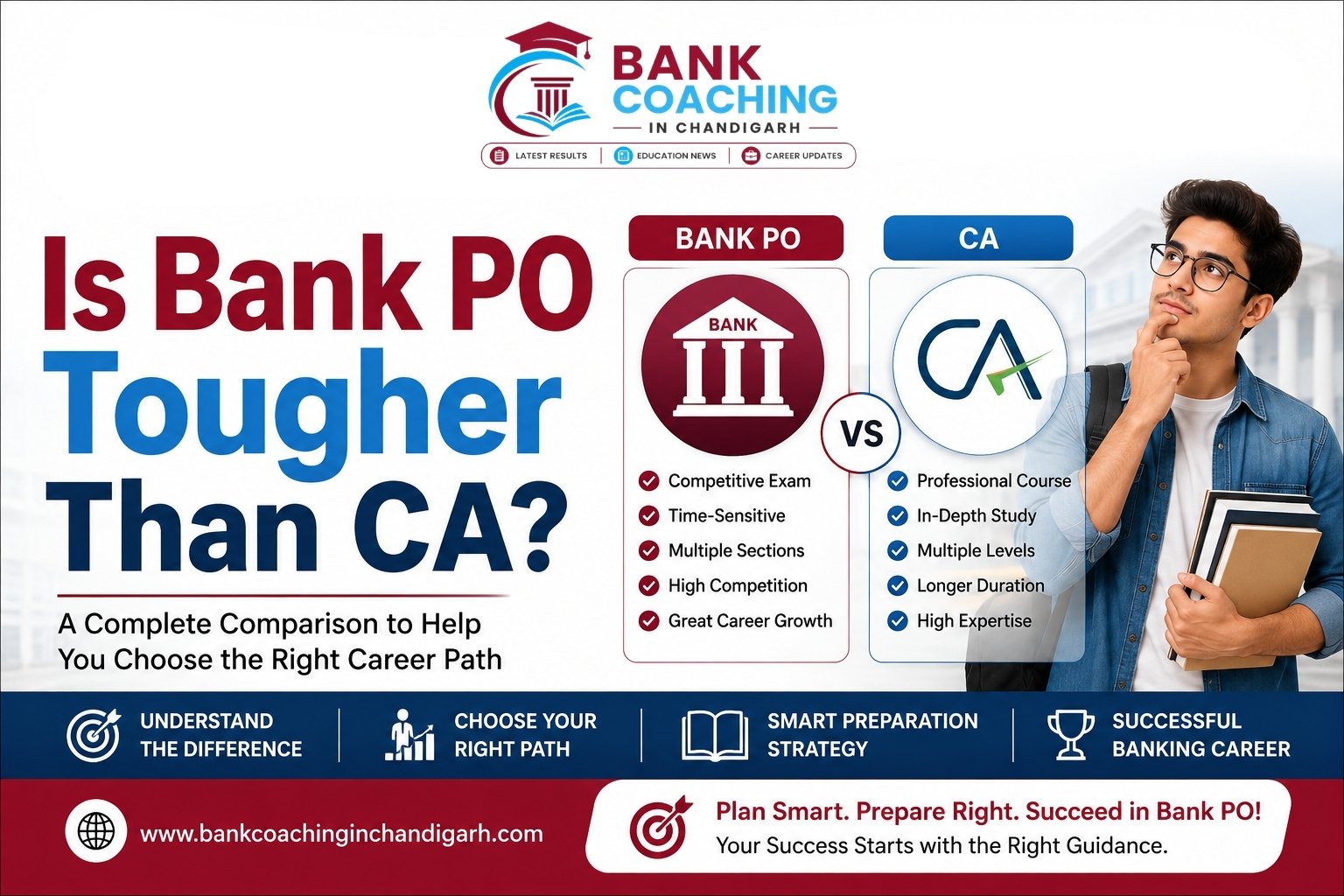
It is difficult to make a direct comparison because the examinations test different skills and have different structures. CA involves extensive professional-level accounting, taxation, law, finance and related subjects, while Bank PO focuses on aptitude, reasoning, English, awareness and other examination-specific areas. Difficulty depends on the candidate’s academic background and strengths.
5. Can an average student crack Bank PO in one year?
Yes. Academic performance alone does not determine Bank PO success. An average student can build the required skills through consistent study, concept development, timed practice, mock tests and regular revision. A disciplined one-year preparation plan can make the goal realistic.